Fifteen questions a Bradenton homeowner can ask before buying a whole-home generator. Sizing, licensing, permits, warranty, and service — what to ask, and what a good answer sounds like.
A whole-home standby generator is a large purchase, and an unusual one: it involves electrical work, gas work, permits across two trades, utility coordination, a manufacturer warranty, and ongoing maintenance. Several trades and several documents have to line up.
In Manatee County we regularly see generators that were sized without a load calculation, sited where heat or corrosion will shorten their life, or left without maintenance, and we hear from owners whose installer stopped returning calls once the sale was done. An extra hour of questions up front is worth it.
This is a fifteen-question checklist from a family-owned generator dealer in Bradenton. As of September 2026, Air & Energy is the only Kohler dealer in the Tampa Bay area holding both Titanium Dealer and Titan Certified status. We also repair and maintain all makes and models, including Generac.
Two of these three are genuinely pass/fail: the licenses and the permits. A dealer who doesn't hold both licenses can't do the whole job, and an install without both inspections closed isn't finished. The certification question is judgment — it tells you what a dealer has invested in, not whether they're allowed to do the work.
A generator installation involves two kinds of licensed work: the electrical tie-in and the gas line. A dealer licensed for only one has to bring in a second company for the other — which can mean separate permits, separate schedules, and separate warranty paths — and a slower answer if something needs attention at the interface years later.
Ask: Do you pull both permits? Do you do gas work in-house? What's the call-back process if the gas side needs attention two years from now?
Air & Energy: Holds both licenses — EC13011350 (electrical) and CFC1429106 (plumbing and gas). Ask us which permits we pull on your job and who handles a gas-side call-back.
Manufacturer certification programs vary by brand, and the requirements behind each certification are set by the manufacturer rather than the dealer. Ask which certification the dealer holds for the brand they are selling, what it required, and when it was last renewed.
You can confirm a dealer's certification on the manufacturer's own dealer locator rather than taking it on trust.
Air & Energy: As of September 2026, the only Kohler dealer in the Tampa Bay area holding both Titanium Dealer and Titan Certified status. Titanium is Kohler's top sales and installation tier; Titan is its top service tier.
Generator installs require inspections on both sides. Some dealers skip the gas permit or let the homeowner pull it. Both are red flags.
Ask us these same questions. Schedule a free generator estimate and we'll go through them with you at your house, with the price in writing. Already holding another company's quote? We'll review it with you for free.
Six questions about how the equipment gets chosen and where it goes.
Sizing is the decision everything else rests on, and it's one of the parts of a generator install most likely to get shortcut — because a rough guess looks the same on a proposal as a real calculation does. A 20kW air-cooled unit isn't automatically right for a 2,800 sqft home. It depends on your AC tonnage, electric water heater, well pump, and intended circuit coverage (whole-home vs. essentials-only).
Code requires a full electrical load calculation on the home. A proper one accounts for what has to start at the same time, especially large motor loads such as the AC, and for the fuel supply feeding the unit. An undersized generator may struggle to start the AC or carry the house; an oversized one costs more than it needs to. Ask how the size was calculated and what it assumes will be running. We'll show you the load calculation on paper.
Air-cooled units cost less and are simpler; liquid-cooled units cost more, generally run quieter, and are built for higher sustained loads. Which one suits your home depends on the load calculation, the site, and how much of the house you want running during an outage — not on square footage. A dealer should be able to explain the choice in terms of your load numbers.
Most Manatee County homes use either natural gas (via utility meter) or propane (via owned or leased tank). Natural gas requires verifying meter size and line pressure — an undersized meter can starve the generator during operation, and a utility upgrade takes time to schedule. Propane requires matching tank capacity to the runtime you want; ask the dealer to show the arithmetic for the unit being quoted. Ask for fuel-supply sizing in writing before committing to equipment.
Every generator has manufacturer-specified minimum clearances from structures, windows, and openings, and they vary by model — ask which clearances apply to the unit being quoted and how the proposed location meets them. Placement should also stay clear of dryer vents, HVAC condensers, and irrigation heads — all of which can shorten generator life through corrosion or overheating.
Near the water, salt air is the governing factor. Ask what enclosure material is specified, how the site was chosen with corrosion in mind, and what the manufacturer recommends for coastal placement.
The transfer switch has to match your main panel's amperage rating. An undersized switch limits what the generator can carry, and the type — service-rated or not — changes how your meter and mains are configured during an outage. Ask which ATS model is being specified and why it fits your panel.
Many Manatee County communities — particularly Lakewood Ranch, Palma Sola, and various deed-restricted subdivisions — require architectural review for generator placement, screening, or enclosure type. Ask whether the dealer has worked in your community before, and who prepares and submits the architectural-review paperwork. Sorting this out after permits are pulled can delay the install or force the generator to move.
Three questions about what happens after the install.
Warranty terms vary by manufacturer, by model, and by generation, and the summary line on a brochure often isn't the whole story. What matters is which components are covered, in which years, and whether labor is covered in each of those years. Ask the dealer for the manufacturer's written warranty document for the exact model being quoted, and read the year-by-year table yourself. Don't accept a verbal summary.
That year-by-year detail is where the real difference sits. A standby generator does almost nothing for years and then has to run for four days straight, so the coverage that matters most is the coverage still in force in year six — not the headline on year one. Ask the dealer to walk you through the coverage year by year, not just “5 years parts and labor.”
Most manufacturers offer an extended warranty, priced and structured by model. Ask what the extension actually covers, which years it applies to, whether labor is included during the extension, and what it costs for the unit you're being quoted — in writing, before you sign.
Standby generators need yearly maintenance: oil changes (hour-based), spark plugs, air filters, battery checks, load testing, and a check that the app is still connected. Manufacturer warranties generally set maintenance requirements, so ask what the warranty for your model requires and what documentation you need to keep.
Ask what's included in year one, what annual maintenance involves after that, and who will be doing the work. A dealer worth hiring will also maintain a generator it didn't sell; we maintain all makes and models, including Generac.
A generator's real test is hour 14 of an outage with a fault code on the display. Who picks up matters more than any spec sheet.
The real test of a generator dealer is when the power's been out for 14 hours, the generator throws a fault code, and you need someone on-site. Ask specifically: If my generator fails during a named storm, what's the response process? Do you prioritize existing customers? How fast can a technician be on-site? The answer should be specific — not marketing language.
Air & Energy: Ask us to walk you through our storm-season service process. Maintenance customers get priority in storm season, though we'd rather explain how it actually works than quote you a response time nobody can control, since access, road conditions and the storm itself all affect it. We offer emergency service on nights and weekends; after office hours, calls go to an automated on-call system that our own technicians respond through. Titan, Kohler's top service tier, is the certification we care about most.
Generators are relatively new to many Florida homeowners, and some dealers have been installing them for decades while others started recently. Longevity matters because a standby generator is meant to last many years, and you want the dealer still in business for later warranty work, maintenance, and troubleshooting. Ask how long they've been installing generators here.
Air & Energy: Installing and servicing generators in Manatee County as part of a business founded in 1983 and run by the Moon family since 1991.
Ownership affects who is accountable when something goes wrong years after the sale. Ask who owns the company, and whether service is dispatched locally or through a regional queue.
Air & Energy: Family-owned and run by the Moon family since 1991, with no outside capital and not by a private-equity platform. Read the promise we hold ourselves to.
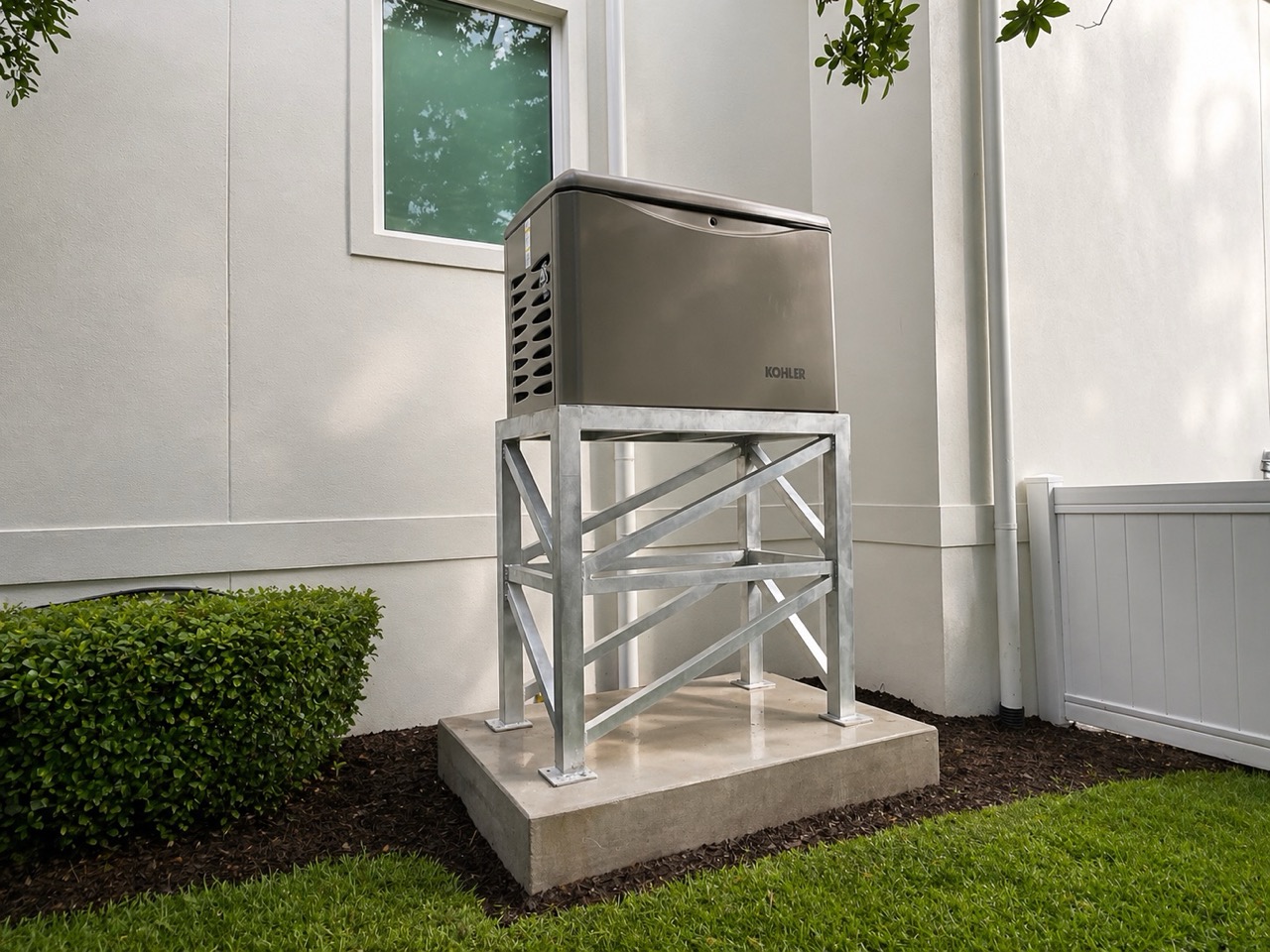
Flood-zone install on an aluminum elevation stand. Ask your dealer whether elevation is required at your address and what the stand is rated for.
Install decisions and maintenance are what determine whether a generator carries the house during a storm. Ask how the load was calculated, how the site was chosen, and what the maintenance schedule looks like.
Runtime depends on the unit, the load it's carrying, and the fuel supply feeding it. On propane, ask the dealer to show the tank-size arithmetic for the runtime you want and plan on topping off before a storm. On natural gas, ask what happens to your supply in an extended outage, and confirm meter size and line pressure in advance.
Kohler's Energy Management app, which replaced the older OnCue app, and similar apps from other brands show you on your phone whether the generator is ready, whether its scheduled self-test ran, and what it has logged. What's available depends on the model and controller. Ask whether the app is set up as part of the install, who else is added to the alerts, and what you should do when one comes through.
Corrosion on coastal properties develops quietly over years rather than showing up in the first season. Coastal homes should specify a corrosion-resistant enclosure from the start, and placement should be chosen with salt exposure in mind.
These are the calls we get after someone else's install didn't hold up — which is exactly why we lead with them.
A generator that was sized without a load calculation, sited poorly, or left unmaintained may not carry the house when the power goes out. The failure usually shows up during the outage, not before it.
Electrical-only dealers arrange the gas work separately. That can mean separate permits, separate schedules, and separate warranty paths — and it can leave a question about who owns a problem at the point where the two sides meet.
Salt air works on an outdoor enclosure slowly and mostly out of sight. Coastal installs need a corrosion-resistant enclosure and a site chosen with salt exposure in mind from day one — two decisions that are cheap on the estimate and expensive to revisit later.
Generator installs are inspected on both the electrical and the gas side. An install where a permit was never pulled or an inspection was never closed can surface later — at resale, at an insurance review, or when a warranty claim needs proof of a permitted install.
Ask us the same fifteen questions. This list isn't a test we wrote for ourselves to pass — it's the set of questions we'd want a homeowner to ask any dealer, including us. Bring it to your estimate, and we'll answer each one for your home: how we sized it, where it goes, which permits we pull, the equipment and transfer switch we're specifying, and the manufacturer's warranty terms for that model. Your price comes in writing before anything is scheduled.
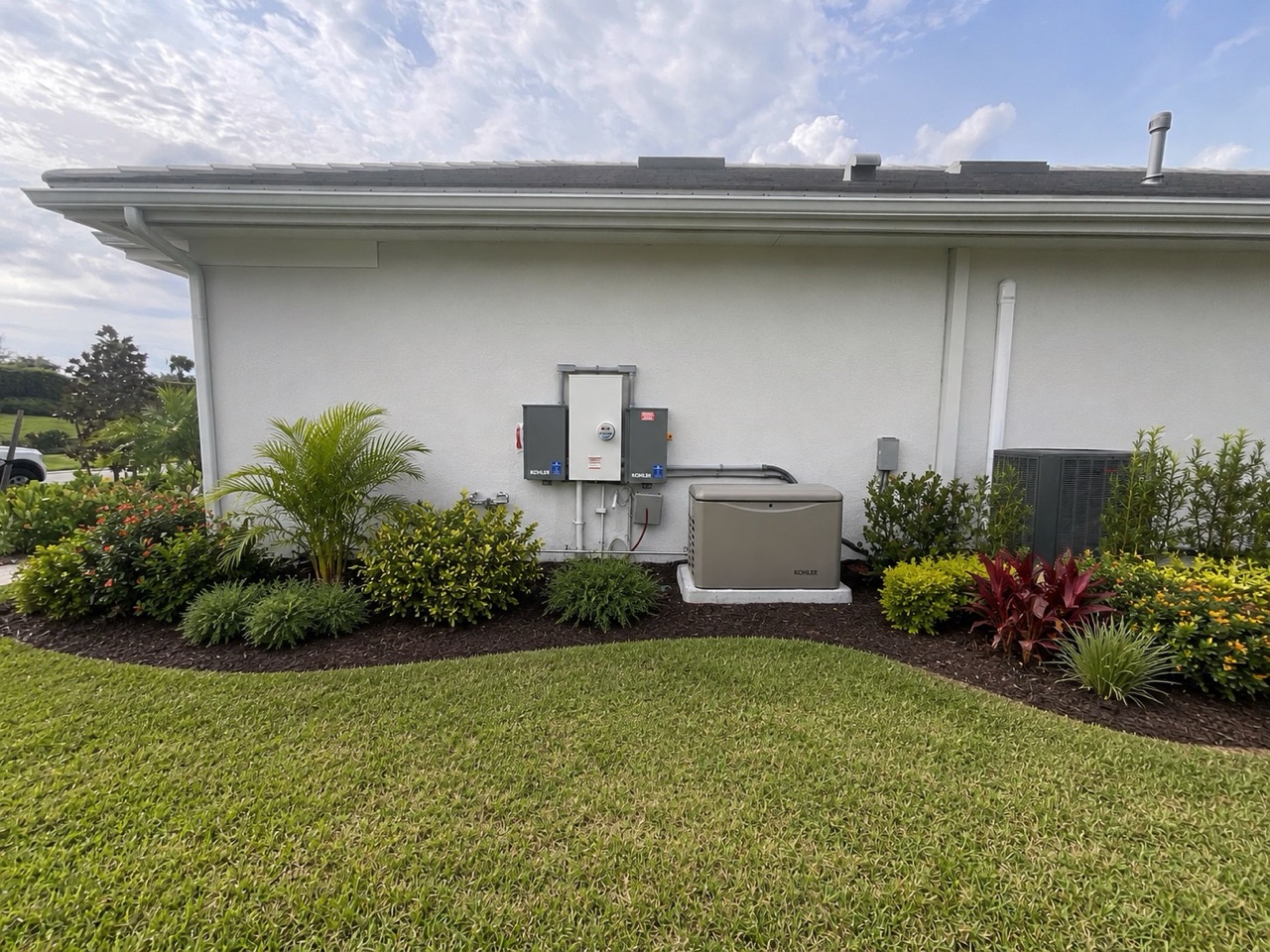
Bradenton install, finished. Transfer switch mounted, gas and electrical permitted and inspected, generator sited to work with the home's exterior.
Bring these fifteen questions to your estimate — ours or anyone's. You can read our Simply Better Promise and our awards and certifications. We hold both the electrical (EC13011350) and plumbing (CFC1429106, which covers gas work) licenses in-house, and as of September 2026 we are the only Kohler dealer in the Tampa Bay area holding both Titanium Dealer and Titan Certified status. Already have another company's quote? Call and we'll review it with you for free. If you're preparing for a visit, our generator pre-visit guide covers what to have ready.