
Whole-Home Generator Installation
Whole-home standby generators installed by our own crews. We sell Kohler. Free estimate, both permits closed.

We install whole-home standby generators in Bradenton, Lakewood Ranch and across Manatee County. The brand we sell and install is Kohler. Air & Energy is a Kohler Titanium & Titan Certified Dealer — as of September 2026, the only Kohler dealer in the Tampa Bay area holding both Titanium Dealer and Titan Certified status.
A whole-house generator is one of the largest single purchases a Florida homeowner makes that nobody can see working. It sits in the side yard doing nothing for years, and then one September night it has to carry your house for four days.
This page is about what a home generator installation actually involves — the estimate, how it gets sized, where the unit goes, what fuel it runs on, which permits get pulled, and what install day looks like on your street. If you want the questions to ask any generator installer, including us, they're on our generator buyer's guide.
Call Air & Energy at (941) 778-0773, or request a free estimate online.
The estimate is free, and it happens at your house
A generator price can't be read off a screen. The pad or stand, the gas run, the electrical run and how the unit gets onto the property are what separate one price from another, so the estimate is a visit, not a phone call.
We look at your fuel and the spot, work out the size you need, and put the price in writing before anything is scheduled. The estimate is free, and there's no obligation.
What size generator do you need? We won't guess over the phone
The number you want is a kW size. We're not going to guess at it, and you should be careful with anyone who does.
Sizing isn't square footage. It comes down to what you want still running when the power's out, and what each of those things takes to start. Air conditioning is usually the largest item. An electric water heater, a well pump, a pool pump, a garage-door opener you'd rather not hand-crank in the rain — each one either lands on the list or it doesn't. Two houses of the same size can land two sizes apart because one of them has a well and the other doesn't.
So the honest version is: we do a full electrical load calculation on your home, as required by code, and then there's a number. What that decides is not just how big the generator is. It's how much of your normal life keeps happening.
Where a standby generator goes
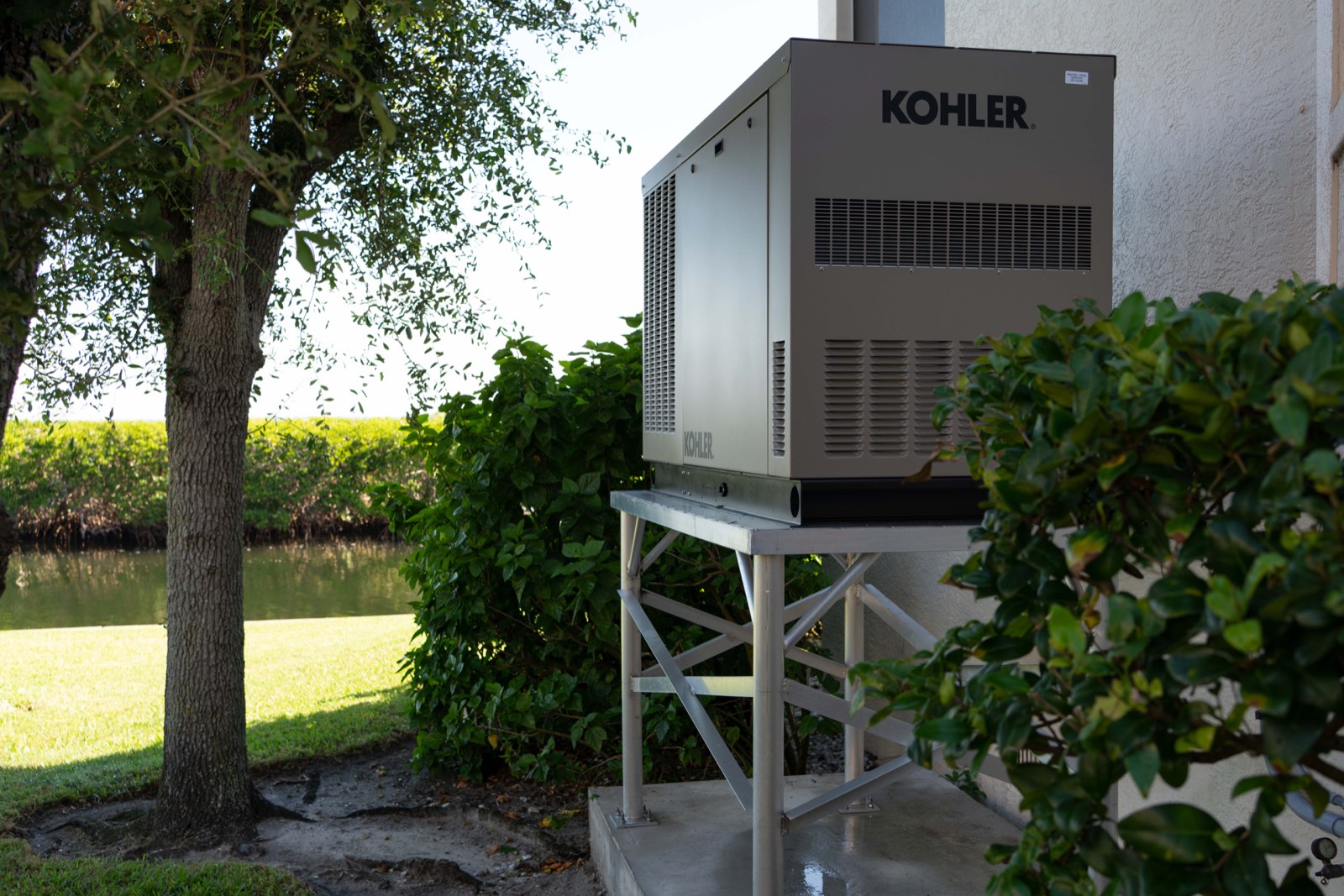
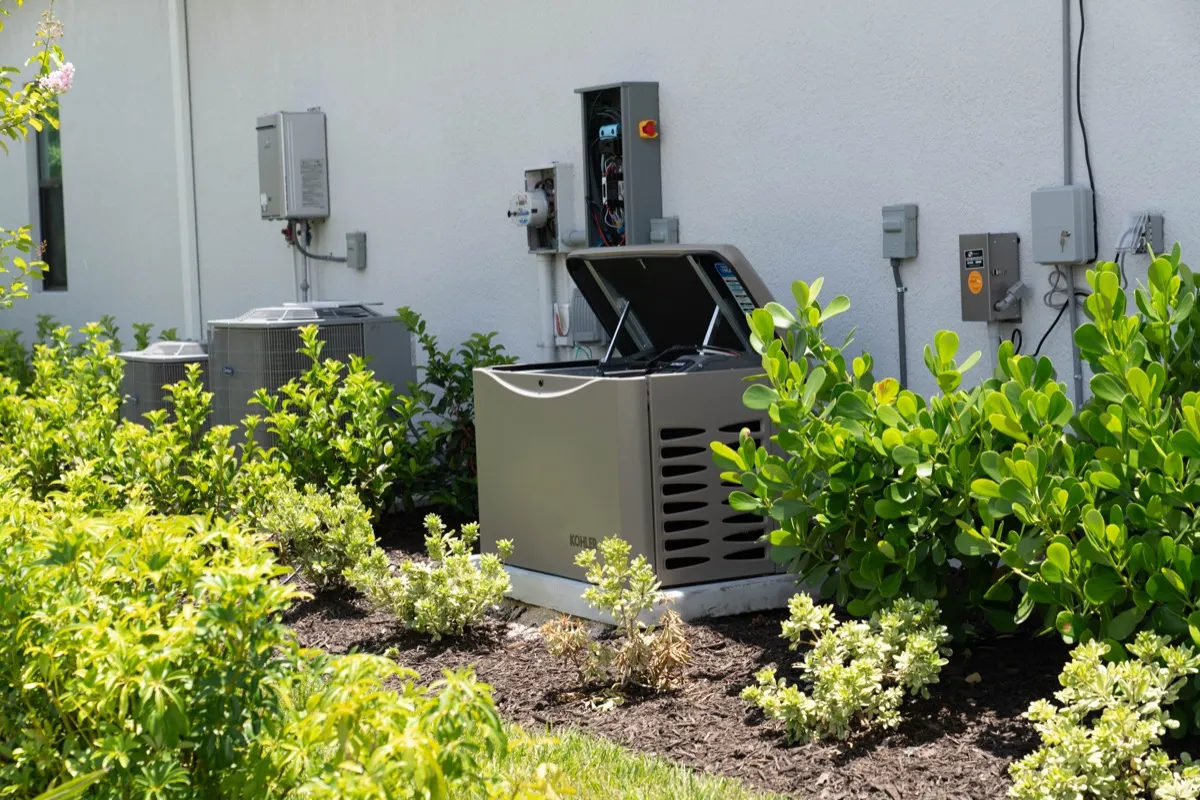
The generator has manufacturer-specified minimum clearances from the house, from windows, and from openings. Those clearances are not negotiable and they are the first thing that rules a spot in or out — which is why one of the first things we do on site is put a tape measure on it.
Then there's the ground itself. Some units sit on a poured concrete pad. Others go up on a welded aluminum stand, off the ground entirely. Which one your address needs is a question worth asking early, because it changes the pad, the gas run, the electrical run and the crane picture all at once — and it is much cheaper to answer before anything is poured than after.
On the islands and along the canals we also choose the spot with salt exposure in mind. We sell Kohler, which in our experience stands up much better in our coastal environment.
Fuel: natural gas or propane
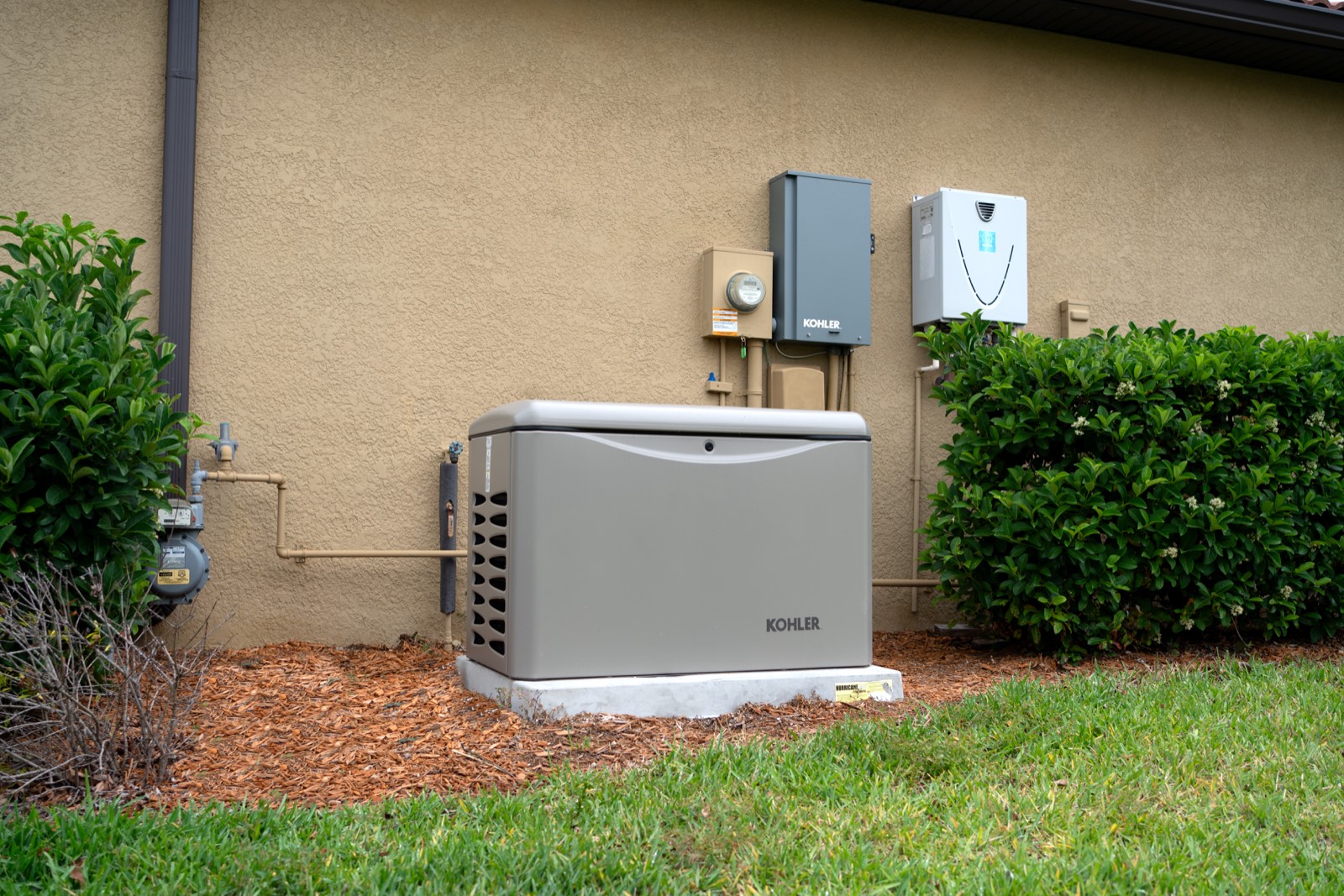
Most Manatee County homes run one of two ways.
Natural gas, through a utility meter. Before this is settled, the meter size and the line pressure have to be verified — a meter sized for a range and a water heater is not necessarily a meter sized for a generator as well. That's a check, not a formality, and it happens before you're quoted.
Propane, from a tank you own or lease. The tank has to be sized for the run-time you actually want, and where it can sit is its own siting question. A tank that's fine for a cooktop is not a tank that carries a house through a multi-day outage.
Either way, this is one of the two permits — see below.
Permits — both of them
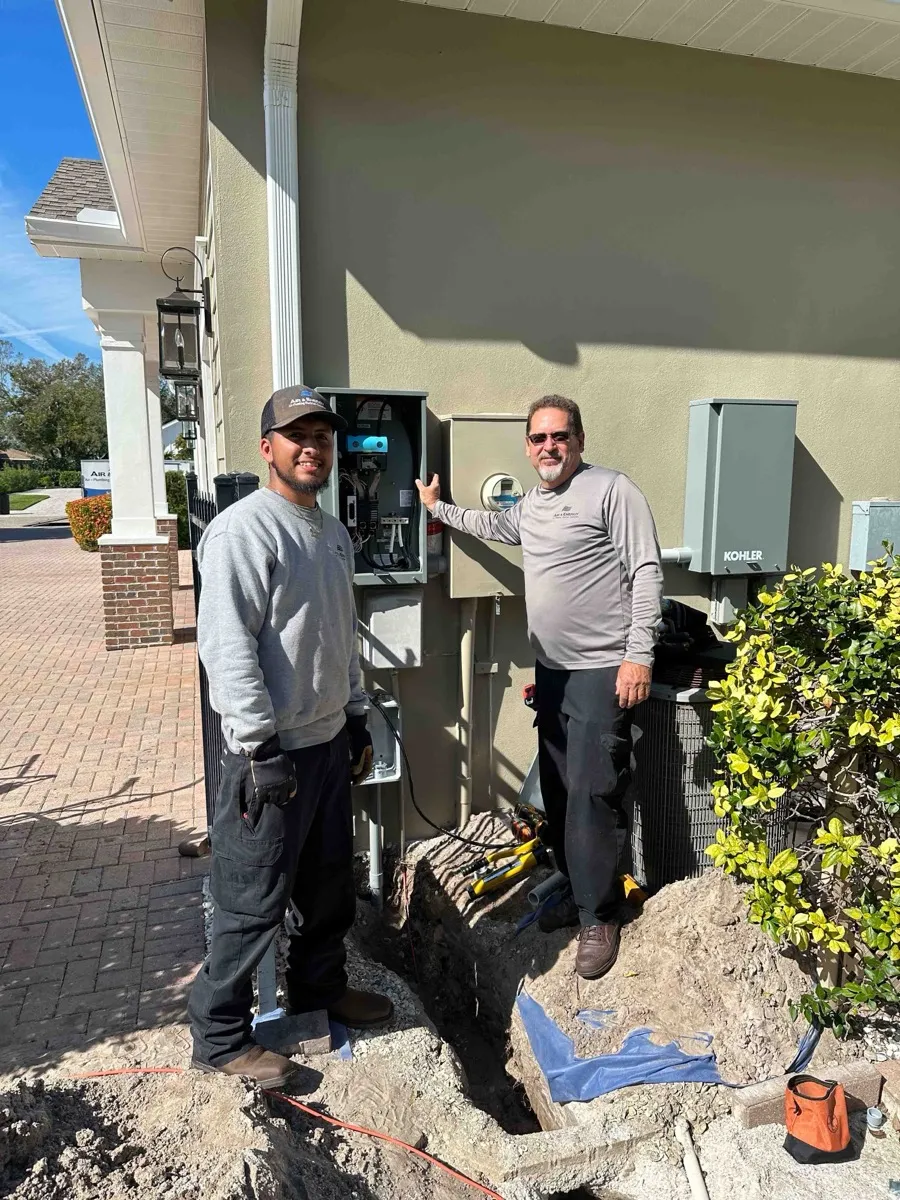
A generator install is inspected on the electrical side and on the gas side. Two permits, two inspections, and both have to be closed.
We pull both and we close both. That's part of the Simply Better Promise, where it's written as “every permit Florida requires — pulled, inspected, and closed by us.” We never ask you to pull a permit yourself; that would move the liability onto you.
The reason to care is unglamorous: an install where a permit was never pulled or an inspection was never closed doesn't announce itself. It surfaces later — at a sale, at a claim, or when somebody else opens the panel. Ask any installer you're talking to whether they'll pull both and close both, and get the answer before you sign.
What generator installation day actually looks like
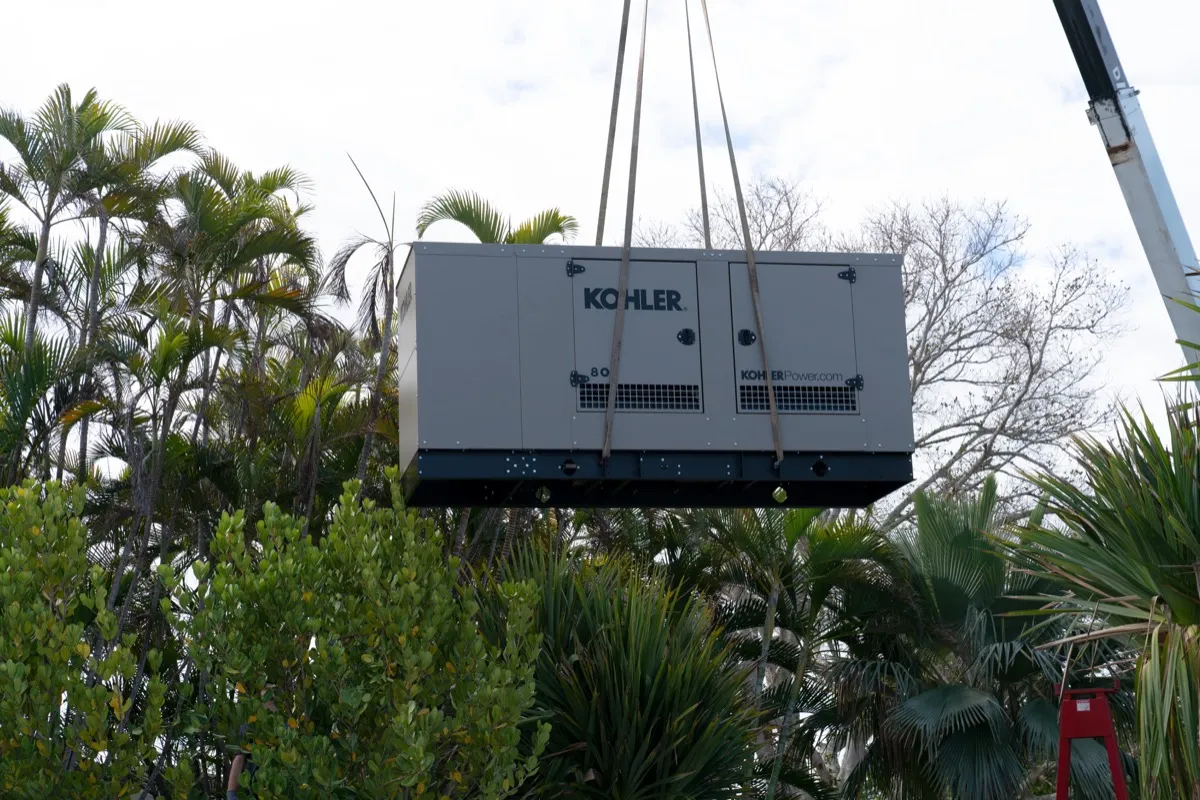
For most of these, the generator does not come in through your side gate. It comes in over the house.
A truck crane sets up in the street. The unit is rigged with straps, lifted over the roofline, and lowered onto its pad or its stand while the crew guides it in from below. Depending on the property and the size of the unit, we've done this over two-story tile roofs, across canals, and onto stands built for the spot. On tight sites we lay plywood over turf and pavers first, because a crane and a laden trailer are heavier than anything that's ever driven across your lawn.
The main installation is usually one or two days on site. The gas work and the final start-up are separate visits, and the inspections are scheduled by the county, not by us — anyone promising you a finish date that includes them is promising you something they don't control.
There are no subcontractors on the install. Every person on your property is a W-2 Air & Energy employee, and we hold all three licenses in-house — HVAC, plumbing and gas, and electrical.
Licenses: CAC1817161 · CFC1429106 · EC13011350.
15 questions every homeowner should ask a generator dealer
Sizing, licensing, warranty, storm response — the things that separate a real install from a botched one.
What happens when the power goes out
The transfer switch is the part that does the deciding. When utility power drops, it disconnects your house from the grid and connects it to the generator, and when utility power comes back it hands the house back and shuts the generator down. You don't do anything. That's the whole point of a standby generator.
Between outages, the unit runs a short exercise cycle on a schedule. That's the generator testing itself, and it is also the single most common way a fault gets found in March instead of in September. Keeping it that way is what generator maintenance and monitoring is for.
When something does go wrong, it usually goes wrong at the worst hour. We offer emergency service on nights and weekends. Outside office hours your call goes to our automated on-call line, and our own on-call technicians respond through it. If you're getting ready for storm season, see generators for hurricane season.
Why we sell Kohler, and what our dealer status means for you
Air & Energy is a Kohler Titanium & Titan Certified Dealer — as of September 2026, the only Kohler dealer in the Tampa Bay area holding both Titanium Dealer and Titan Certified status. Kohler renamed the second program in 2026; it was previously called Bold Certified.
Titanium is Kohler's top sales and installation tier. Titan Certified is the top service tier.
Here's why the second one is the one that matters. A generator that has never had an outage is not a generator anyone has tested. The moment that counts is the one where the power has been out for fourteen hours, the unit throws a fault code, and somebody has to read it correctly at your house. Sales credentials don't help you at that hour. Service credentials do.
We install Kohler. We service everything.
We install Kohler exclusively — one manufacturer, one parts inventory, one set of diagnostics our technicians know cold.
But we service all makes and models of standby generators, whether we installed them or not. If you inherited a unit with the house, or you bought from a dealer who has since sold to somebody else, you do not have to replace a working generator to have somebody competent look after it.
Those two facts are deliberately not the same policy, and it's worth saying why. A company that only services what it sells has a reason to want your working unit gone. We'd rather keep yours running and be the people you call when it doesn't.
What we won't do
We won't size it over the phone. See above. A kW number offered without a load calculation on your home is a guess with a decimal point on it.
We won't quote before we've been to the site. The pad, the stand, the gas run and the crane access are the difference between two prices, and none of the four can be read off a screen.
We won't tell you a generator is the answer if it isn't. Some houses are better served by a smaller scope. If that's yours, we'll say so.
Cost, and paying for it
We don't post a “starting at” generator price, because it would describe a best-case job at somebody else's house. Your price comes from the estimate, in writing. For air conditioning we publish what our own completed jobs have cost on how we price; we haven't done the same work for generators yet, and we'd rather say that than guess.
If you'd rather spread the cost out, see our financing options.
Installs from our crews
We started on Anna Maria Island in 1983 and we've been putting equipment into houses around here ever since — some of it lifted over the roof to get there. Our crews have completed hundreds of generator installations across the area.
Generator installation questions people ask us
Do you install home generators near me?
We install whole-home standby generators across Bradenton, Palmetto, Ellenton, Parrish, Anna Maria Island, Longboat Key and all of Lakewood Ranch, including the Sarasota County side.
Do you install Kohler generators?
Yes. Kohler is the brand we sell and install, and we're a Kohler Titanium & Titan Certified Dealer.
What is a standby generator?
A standby generator, sometimes called a whole-house generator, is installed permanently outside your home and runs on natural gas or propane. When the power goes out, its transfer switch moves your house over to the generator without you doing anything. A portable generator has to be set up, fueled and connected by hand.
Is the estimate free?
Yes. We come to the house, look at the panel, the fuel and the spot, and give you the price in writing. There's no obligation.
How much does a whole-home generator cost?
It depends on the size you need, the fuel, and whether the unit goes on a pad or a stand and in over the roof. We don't quote a number over the phone as if it were your price. The estimate gives you your actual price, in writing, before anything is scheduled.
What size generator do I need?
It depends on what you want running in an outage — air conditioning, water heater, well or pool pump — not on square footage. We do a full electrical load calculation on your home, as required by code, before we give you a size.
How long does generator installation take?
The main installation is usually one or two days on site. The gas work and final start-up are separate visits, and the county schedules the inspections.
Do you pull the permits?
Yes, both of them — electrical and gas — and we close both inspections. You never have to pull a permit yourself.
Natural gas or propane?
Either. For natural gas we check the meter and line pressure first; for propane, the tank has to be sized for the run-time you want. Both are settled before you're quoted.
What warranty comes with it?
The generator carries Kohler's factory warranty. Ask us for the current terms in writing with your estimate. Our own workmanship is guaranteed for one year on everything we do.
I already have a generator from another company. Can you help?
We install Kohler only, but we service all makes and models, whoever installed them.
Start with somebody in your side yard
If a generator is somewhere on your list, the next step is somebody standing in your side yard with a tape measure. We'll come out, look at the panel, the fuel and the spot, and put the price in writing before anything is scheduled.
Call (941) 778-0773