Indoor Air Quality
Musty smell, dust or sticky air? What humidity control, filters, UV lights and duct cleaning really do.



Where are you right now?
Hardly anyone calls us about "indoor air quality." They call because the house smells musty, the dust is back two days after cleaning, or a salesperson just quoted them a box for the air handler. Start with whichever sounds like your house.
It smells musty, or the house feels sticky. Humidity is a common, often-overlooked factor in our climate.
The dust comes right back. The filter, how it fits, and the ductwork behind it.
Someone in the house has allergies. What your AC system can reasonably change.
We just renovated, or the house is new and tight. Construction dust, fresh air and trapped moisture.
Someone tried to sell me an air purifier or duct cleaning. What the EPA says, and what to ask.
What do you actually install? UV lights at the coil, APCO, media filter cabinets and whole-home dehumidifiers.
I just want better filtration. What MERV means, and why the slot matters.
It smells musty, or the house feels sticky
Your air conditioner is also your main dehumidifier: as warm air crosses the cold indoor coil, moisture condenses and runs out the drain line. So the EPA's advice to keep indoor humidity below 60 percent, ideally between 30 and 50 percent, is largely an AC question here (EPA). Trouble starts when the system cools without drying: on mild, muggy days when it barely runs, in homes closed up while the owners are away, or when it cools quickly and shuts off before pulling much water out, leaving a house cool but clammy (Mississippi State Extension).
A musty smell from the vents tells you something is damp, not where. It could be the coil, a drain pan that holds water or a slow drain line; the ductwork; or moisture in the building itself, such as a roof or plumbing leak, or hidden mold somewhere the system pulls air from. Finding the source is the first step. We check the AC side (coil, drain pan and line, air handler closet, filter, reachable ductwork, and how the system runs) and tell you what we found. If the smell is more sewer than musty, it's often plumbing, such as a dry drain trap in a bathroom nobody uses, and we're plumbers too.
We don't test for mold, and we don't remove it. If you suspect mold, hire a mold professional of your choosing. The EPA suggests a professional when mold covers more than about 10 square feet, when sewage or other contaminated water caused the damage, or when the heating and cooling system itself may be contaminated, in which case it advises not running the system. With health concerns, it says to see a health professional before cleanup (EPA). What we fix is the AC-side moisture that lets mold grow.
We install whole-home dehumidifiers regularly. One makes sense when the AC is working properly and the house still runs damp: a home that stays clammy through mild, muggy weather, or one closed up for months while the owners are away. It's a separate appliance tied into your ductwork, with its own drain, that takes water out of the air whether or not the AC is cooling. It won't fix a leak, a wet wall or an AC system that needs repair, which is why we check those first. Replacing your AC anyway? Raise humidity at the start; the repair or replace guide covers the rest.
The dust comes right back
Fast-returning dust usually traces to the filter, its fit, or the ductwork. A thin, low-rated filter lets much of the fine dust through. A filter with gaps around its edges lets air go around it. And leaky return ductwork can pull in dust from the attic or wall cavities; depending on where the leak sits relative to the filter, some of that dust can reach the system without passing through the filter at all. A central filter also works only while the fan runs. We check the filter, the slot and the return side; the fix might be a better filter, a duct repair or, occasionally, duct cleaning.
15 questions every homeowner should ask an HVAC contractor
License verification, permits, a matched system, ductwork and written warranties — the things that decide whether an AC install actually fits the house.
Someone in the house has allergies
We can't treat allergies or asthma, and nobody selling equipment for your air handler should promise to; that's a conversation for your doctor. What your system can change is what it circulates and how damp the house is: humidity in the EPA's range, a better filter that fits its slot, and a coil and drain pan that aren't growing anything.
We just renovated, or the house is new and tight
Renovation dust gets pulled straight into the returns. Heavy debris in the ducts is one case where the EPA says duct cleaning is worth considering (EPA); we'll look before recommending it.
A tight, newer house holds on to moisture and smells. The EPA puts source control (keeping pollutants and moisture from building up) and ventilation (replacing some indoor air with clean outdoor air) first, and calls filtration a supplement to them, not a substitute (EPA). Here, outdoor air brings humidity with it, so fresh air and moisture control have to be weighed together. If a newer home feels stuffy or damp, we start with humidity and how the system runs.
Someone tried to sell me an air purifier or duct cleaning
Air quality is easy to oversell, because you can't see the result. Here is what the EPA says.
- UV lights. Typical home units have limited effectiveness at killing mold and bacteria, and many spores need far more UV than a home unit delivers. A properly designed lamp aimed at the wet coil and drain pan may help keep those surfaces cleaner (EPA). That surface is where a UV light earns its place; treating the air rushing past is not something we'd count on.
- Ionizers, including bipolar ionization. An emerging technology with little research outside lab conditions, which can produce ozone and other by-products (EPA). We no longer sell ionizers.
- Ozone generators. No federal agency has approved them for occupied spaces, and ozone can harm health (EPA). We don't sell them.
- Duct cleaning. Never shown to prevent health problems, and not something every home needs on a schedule (EPA).
None of these replaces humidity control, a clean coil, tight ducts or a filter that fits, and we won't tell you any product kills viruses in your air or cures anything.
Before you sign, ask what problem the product solves in your house, how anyone will know it worked, and what it needs each year. A good answer names your complaint; a weak one leans on germs and fear. If you already have another company's quote, we'll review it with you for free. Our technicians are paid hourly, not on commission.
What we install, and where it goes
Each of these does one specific job, and none of them is a cure-all. The product details come from the manufacturers.
UV lights at the coil
A UV-C lamp mounted inside the air handler and aimed at the cooling coil and the drain pan below it, the cold, wet surfaces where growth gets started. Fresh-Aire UV's Blue-Tube, one we commonly install, is sold with one- or two-year lamps (Fresh-Aire UV), and the lamp is replaced on the manufacturer's schedule.
APCO-X in the supply plenum
APCO-X, made by Fresh-Aire UV, pairs a UV-C lamp with activated-carbon cells in one unit. We install it in the supply plenum, the box on the air handler where cooled air heads out into your ducts. Fresh-Aire UV describes APCO-X as UL 2998 validated for zero ozone, and its manual calls for a new lamp every three years (Fresh-Aire UV). The EPA's caution about treating moving air applies to it as to any UV product.
Five-inch media filter cabinets
A cabinet that holds a filter about five inches deep, installed in the return ductwork or under the air handler. That depth gives far more filter surface than a one-inch filter, so it can catch finer dust without choking the system's airflow. More on filters below.
Whole-home dehumidifiers
For houses that run damp even with a healthy AC. When one makes sense is covered above.
Every one of these needs some upkeep, whether a lamp, a filter or the drain. Ask us about upkeep for what you have.
I just want better filtration
Filters are rated by MERV (Minimum Efficiency Reporting Value) from 1 to 16; higher numbers catch more fine particles. The EPA suggests MERV 13, or as high as your system fan and filter slot can accommodate (EPA). That second half matters: a dense filter in a one-inch slot can choke your system's airflow. A media filter cabinet holds a filter about five inches deep, with far more surface, so it filters well without starving the system. Many systems we look after already have one. If yours doesn't, we'll tell you whether adding one makes sense. Either way, the filter has to seal in its slot; a great filter with air going around it is a poor filter.
Duct cleaning, honestly
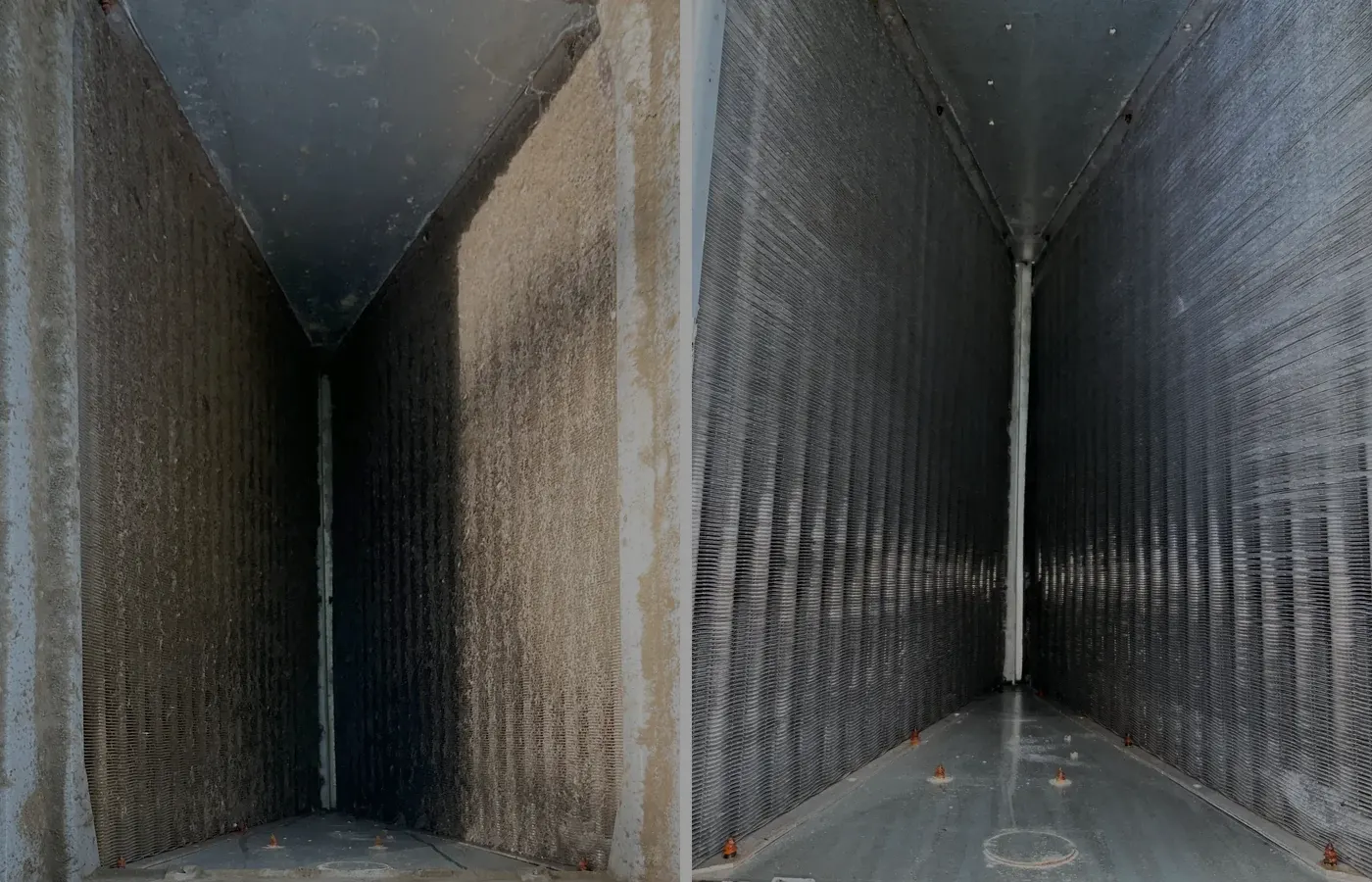
We offer duct cleaning, and we'll tell you when you don't need it. The EPA says to consider it for visible mold inside hard ducts or other system parts, rodents or insects in the ducts, or enough dust and debris to clog them or blow out of the vents (EPA). It won't stand in for a decent filter or fix ducts that are crushed, disconnected or leaking; those need repair, and soaked or damaged flexible duct often needs replacing. We repair and seal ductwork as well as clean it.
What a visit looks like, and how it's priced
Call us, or request a visit online and the office will text or call you, whichever you choose, to set a time. A technician checks the air handler, coil, drain, filter and reachable ductwork, and explains what they found. Everyone we send is an Air & Energy employee. If something needs repair, they give you the expected repair cost before starting. Larger work, such as a dehumidifier, a media filter cabinet, duct cleaning or duct replacement, is quoted in writing before work starts.
There's no separate trip or diagnostic fee. Repairs are billed for time and parts, with some at a flat rate, and there's a minimum charge for the visit. Ask us for our hourly rate. Details are on our how we price page. Our VIP maintenance membership includes two scheduled visits a year, priority scheduling, no overtime fees and 10% off all repairs. See also AC repair and water filtration.
Who does the work
Air & Energy has been serving the area since 1983 and has been family-owned by the Moons since 1991. We're a Florida Certified Air Conditioning Contractor, license CAC1817161. Our work carries a one-year workmanship warranty, and we have 4.9 stars, 3,200+ Google reviews.
Common questions
What indoor humidity should I aim for?
The EPA recommends below 60 percent, and ideally between 30 and 50 percent. In a Florida home, your air conditioner does most of that work.
Do UV lights kill viruses in the air?
Not in any way we'd promise. The EPA says typical home UV units have limited effectiveness against bacteria and mold. A properly designed lamp may help keep the wet coil and drain pan cleaner.
Is APCO ozone-free?
Its maker, Fresh-Aire UV, describes the APCO-X we install as UL 2998 validated for zero ozone. We don't sell ozone generators, and we no longer sell ionizers.
Do you install whole-home dehumidifiers?
Yes, regularly. One makes sense when the AC is working properly and the house still runs damp, so we check the AC first.
Is duct cleaning worth it?
Sometimes: for visible mold inside the ducts, rodents or insects, or dust and debris blowing out of the vents. It isn't routine, and we'll tell you if yours doesn't need it.
What MERV filter should I use?
The EPA suggests MERV 13, or as high as your system fan and filter slot can accommodate. We'll check what your system can take.
Will an air purifier help my allergies?
We can't promise that, and we'd be wary of anyone who does. Talk to your doctor; on our side, lower humidity, a filter that fits and a clean coil are what your system can do.
Do you test for mold?
No. We don't test for or remove mold; if you suspect it, hire a mold professional of your choosing. We fix the AC-side moisture problems that let mold grow.
Tell us what you're noticing
The smell, the dust, the sticky air or the quote on your counter: tell us which, and we'll tell you plainly what we find. Call (941) 778-0773 or request a visit online.